
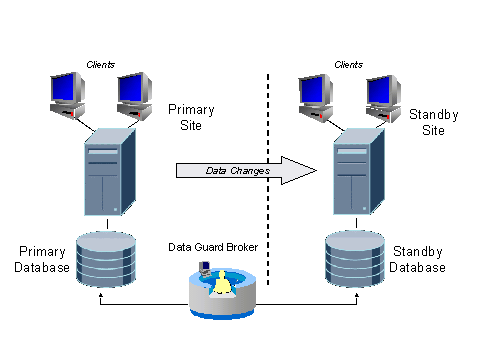
To assist you in better understanding Oracle Data Guard and how it connects to other Oracle high availability (HA) and disaster recovery (DR) solutions, the following comparison and optional illustration are provided:
🔄 Comparison of GoldenGate, Active Data Guard, and Data Guard Features and Use Cases Data Protection Guarding Active Data The primary goals of Oracle GoldenGate are disaster recovery and high availability. DR and real-time reporting Real-time integration and replication of data Synchronization of Data Rework the log shipment Log shipping again with read access SQL-based logical replication Type of Standby Snapshot, Logical, and Physical Logical replication across diverse systems, only physical standby Read-Only Reporting Not accessible (except from logical standby) ✅ ✅ Yes (on the target system) ✅ Yes (on physical standby) Automatic Failover
✅ Yes (with Data Guard Broker) ✅ Yes (with Data Guard Broker) ❌ No (requires manual intervention) Granularity of Replication Complete database Complete database Table, Schema, and database latency. Extremely low (almost instantaneous) Very little Low (depending on configuration) Support for heterogeneous databases ❌ No (Oracle-only) ❌ No ✅ Yes (Oracle to/from other databases). Use Cases HA, DR, backup offloading, reporting, and DR Distribution, transfer, and ETL of data in real time.
📊 When Should I Use Which?
If you want high availability and catastrophe recovery in Oracle-only environments, use Data Guard. If you require both live reporting from a synchronized copy and disaster recovery, use Active Data Guard. If you require cross-platform replication, zero-downtime migrations, or table/schema level replication, use Oracle GoldenGate.
📉 Oracle Data Guard Architecture in a Simple Diagram [Users/Applications] | Primary DB Active database └────────────┘ | ┌──────────────┼────────────────┐ ▼ ▼ [Transport Redo] [Transport Redo] (Sync or Async) (Sync or Async) | | Physical, logical, standby database, standby database, standby database, standby database, real-time application, SQL application, and so on. Read-only queries (Active Data Guard) are optional.
📌 Data Guard is a dependable, Oracle-only catastrophe recovery system.
Active Data Guard: Provides standby real-time reporting capabilities. GoldenGate is more adaptable and allows for finer-grained replication and heterogeneous databases.
https://shorturl.fm/XiUwe
https://shorturl.fm/XMXY2
https://shorturl.fm/cghUl
https://shorturl.fm/gO6r9
https://shorturl.fm/PoTF8
https://shorturl.fm/aiOQY
https://shorturl.fm/VHskc
https://shorturl.fm/MSQGN
https://shorturl.fm/POqR6
https://shorturl.fm/qHFOe
https://shorturl.fm/oGtMk
https://shorturl.fm/GSLlA
https://shorturl.fm/l3mJb
https://shorturl.fm/32gek
https://shorturl.fm/k671O
https://shorturl.fm/614lX
https://shorturl.fm/mlmUd
https://shorturl.fm/0WE30
https://shorturl.fm/MXdsx
https://shorturl.fm/OpsSa
https://shorturl.fm/0R3WQ
https://shorturl.fm/Y87es
https://shorturl.fm/PIa54
https://shorturl.fm/hntpD
Join our affiliate community and earn more—register now!
Join our affiliate program and start earning today—sign up now!
Join our affiliate program and start earning today—sign up now!
Refer and earn up to 50% commission—join now!
Monetize your influence—become an affiliate today!
Unlock exclusive rewards with every referral—enroll now!
Drive sales and watch your affiliate earnings soar!
Promote our products—get paid for every sale you generate!
Earn up to 40% commission per sale—join our affiliate program now!