
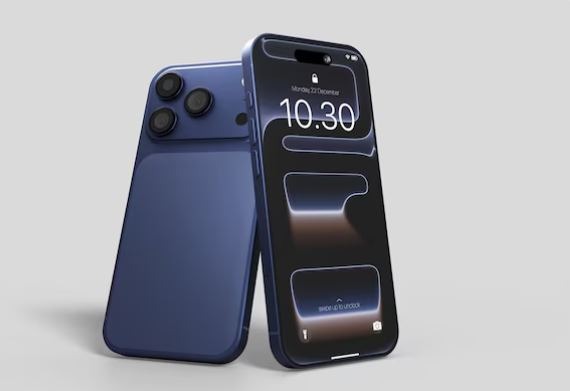
There is a certain quiet confidence in Apple’s recent decisions. The iPhone 18 Pro Max appears to be less about flair and more about refinement. No extreme shape-shifting or exploding specifications sheets, just a number of well-considered enhancements that combine to produce something extraordinarily potent. At first sight, the design appears to be familiar. The fact that the silhouette is not moving all that much may make it seem anticlimactic to others. But there is a certain elegance about constraint. It is what distinguishes notable advancements from being lost in the background.
iPhone 18 Pro Max – Key Facts (Rumored)
| Feature | Detail |
| Expected Release | September 2026 |
| Processor | A20 Pro chip (2nm), highly efficient |
| Battery Capacity | 5000–5200 mAh (varies by SIM version) |
| Display | 6.9-inch OLED, 120Hz LTPO, reduced Dynamic Island |
| Camera | Variable aperture main lens, enhanced telephoto lens |
| Face ID | Under-display (Pro models only) |
| Design Shift | Minimal external changes, major internal upgrades |
| Foldable Variant | Expected alongside Pro models with new form factor |
Take the camera, for instance. A variable aperture lens on the primary sensor is reportedly under consideration. Photography is fundamentally changed by altering the quantity of light that hits the lens instead of just post-processing shadows after the fact. Photographers are accustomed to this method, which was later reduced in size from larger cameras. If Apple accomplishes this correctly, night photos might have a completely distinct personality. A thorough modification is being made to battery life. Instead of increasing bulk, Apple seems to be changing internal architecture to make room for a larger battery. That move seems particularly beneficial given how much we now depend on our phones for power-hungry tasks like video editing, augmented reality, or even prolonged continuous viewing. The A20 Pro chip could be the quiet star of this generation. Its 2nm design provides a significantly faster and more energy-efficient performance. Users may anticipate improved thermals, reduced lag, and—perhaps most importantly—reliability under stress. When handling FaceTime talks, songs, and maps while stranded on a rural rail platform, that kind of regularity is crucial.
My phone overheated and dimmed its screen during an airport layover just when I needed it most, while I was reading about the chip’s performance benchmarks. A more compact, powerful, and cooling CPU would have made that experience much easier to manage. Furthermore, Face ID may eventually make the transition—below the screen, out of sight. That change is more complicated than it seems. The objective is to recover visual space. Although Apple’s ever-diminishing Dynamic Island may still be present for notifications, the sensors may vanish beneath the glass, making the interface feel much cleaner.
The Pro Max is not the only experiment in this cycle, though. It may be accompanied by a foldable iPhone with two screens and new gestures. Not everyone will use the model as their daily vehicle, despite the fact that its amazing form is sure to attract attention. Long-lasting, incredibly reliable, and quietly confident, the Pro Max still feels like the anchor. Aspects of camera innovations include variable aperture. Rumor has it that the telephoto lens’s faster aperture aids in low-light zoom photography and background blur. Photographers will see that, despite the slight change, it is much better. Selfies might also be enhanced with a sharper 24MP front camera.
It seems that Apple’s engineers are more focused on fixing problems that come up after years of use than they are on keeping up with trends. The things that make a phone feel good in your hand after 18 months are heat management, minor lens changes, and more user-friendly UI options, even though they are not really notable enhancements. Connectivity may also improve. If a new Apple-designed modem takes the place of a Qualcomm one, users might notice a faster network acquisition and fewer signal dropouts. It is the kind of stuff that gets acclaim at launch parties but none at two in the morning in a hotel room with practically any bar or reception. There is not a 200MP sensor this time. Not a showy overhaul. But maybe that is precisely the purpose. All this iPhone has to do is do what it does now, just better. It does not have to start over.
This model might be a refreshing change of pace for those who are holding out for an iPhone 15 or 16 Pro Max. It is not meant to boast, but to empower you to achieve more in a calm, confident way. In an era of continual noise, that kind of complexity feels like a design choice in and of itself.